
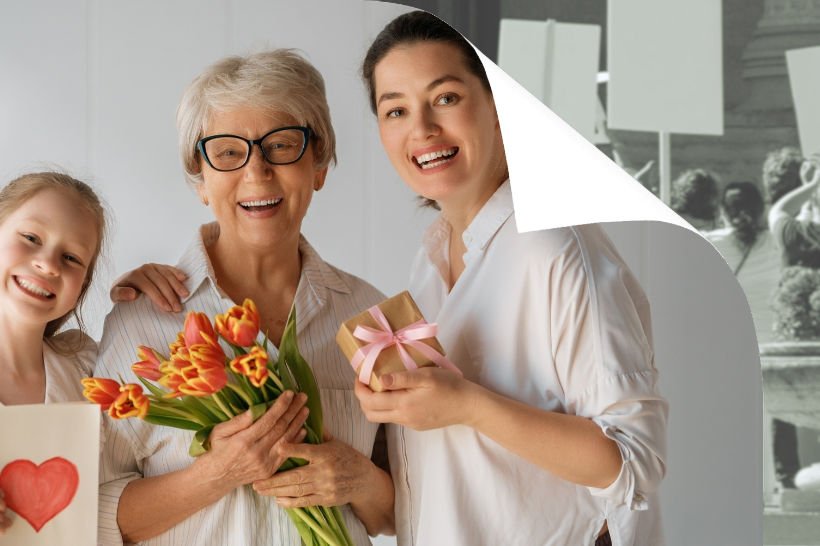
I always like to know why we do things. Not in a grumpy way, more in a curious “who invented this?” sort of way. If we’re all buying cards and flowers and booking Sunday lunch, I just want to know where it started. So I did what I always do and went down a little research rabbit hole. And honestly, Mother’s Day wasn’t what I expected at all.
When I started looking into why we celebrate Mother’s Day, I discovered it wasn’t originally soft and pastel and full of brunch bookings. It began, in part, as a protest.
In America, before it became the Mother’s Day we recognise now, women gathered in what were called “Mother’s Day for Peace” meetings. They were responding to war. They were organising and asking for change.
Later, a woman named Anna Jarvis campaigned to make it an official day to honour mothers. It was recognised nationally in 1914 by Woodrow Wilson. And then it became commercial very quickly. In fact, Anna Jarvis eventually protested against the holiday she had created because she felt it had lost its meaning. Which I find fascinating. And a little ironic.
Because we often do this, don’t we? We take something strong, slightly revolutionary and a bit uncomfortable… and we soften it to make it palatable. A spoonful of sugar and all that.
And that’s when I started thinking about bees.
Bees are not what we think, either
The media often portrays bees as cute fuzzy little creatures drifting lazily between flowers. A bit bumbling. Harmless. Almost cartoonish.
And they are beautiful. When you watch one properly, dusted in pollen, moving with complete focus, it’s hard not to feel in awe. But the truth is, a hive is not soft.
A hive is organised. Purposeful. Entirely built around survival. There is one mother – the Queen – and her role is very specific. At the height of the season she can lay up to two thousand eggs a day. It’s astonishing. But she isn’t nurturing in the way we tend to picture motherhood. She isn’t tending to larvae or checking everyone’s alright. Her job is biological and relentless. She keeps the colony going. That’s it.
The nurturing – if we want to call it that – is carried out by thousands of female worker bees. They feed the young, clean and repair the hive, regulate its temperature with remarkable precision, defend it when threatened and later in life fly out to forage. Every role shifts as they age. Nothing is random.
And if the Queen falters? The colony quietly replaces her. As humans, this is so hard to hear or comprehend, but there’s no sentimentality in it. No cosy bedtime stories. Just a collective, instinctive commitment to keeping the whole alive.
Which makes me think we’ve perhaps softened the bee story a little too.
From protest to pastel: why do we celebrate Mother’s Day today?
When I read about the beginnings of Mother’s Day – the activism, the organising, the slightly uncomfortable roots of it – I couldn’t help smiling at how far we’ve drifted from that story. And then I thought about bees again. Entirely powered by structure and survival… and yet most of the time we meet them as illustrations on tins and tea towels.
We are very good at sanding the edges off things, aren’t we?
Now don’t get me wrong. I adore a beautiful gift. I love something that feels thoughtful and well made. I love spoiling the people I care about, and I absolutely believe in small, joyful rituals. But I also care about what sits underneath all of that.
Yes, our tins and packaging are pretty. Yes, our balms smell wonderful. I want them to feel like a treat when you open them. But there has always been something quietly rebellious at the centre of what we do here.
- We question ultra-processed beauty because it doesn’t make sense to us
- We question why we’re paying for water dressed up as skincare
- We question ingredients that sound impressive but don’t actually serve the skin
And we care about bees – not just as a motif, not just as branding, but as living, complex systems that quite literally keep ecosystems functioning.
So perhaps Mother’s Day doesn’t have to sit in neat boxes either. Perhaps it doesn’t have to be protest or present, and it doesn’t have to be activism or indulgence. Maybe it’s allowed to be both.
Mother Earth and the bigger picture
And perhaps there’s something else sitting quietly underneath all of this.
We call the planet “Mother Earth” without really thinking about it. It’s such a familiar phrase that we forget what it implies:
- The soil that grows our food
- The plants that feed the bees
- The bees that pollinate the crops
- The skin we’re trying to care for
It’s all connected.
The way we treat our mothers says something about what we value. And the way we treat the Earth says even more.
If motherhood, at its core, is about nurturing life and sustaining the future, then supporting the systems that keep life going feels like part of that same instinct.
We decided to give back to wildflower meadow projects, when we support bee-friendly initiatives, when we choose formulations that tread more lightly on the planet, it isn’t a marketing add-on. It’s our small way of tending the wider “mother” that sustains us all.
And of course, we know it won’t fix everything overnight. But it is a turning of the tide: one purchase, one patch of wildflowers, one hive at a time.
So maybe the loveliest kind of gift to honour Mother’s Day is one that feels good to give, feels beautiful to receive… and quietly supports something bigger at the same time.
That, to me, feels like having it all. So, if your mum is the sort to:
- Support a small independent business
- Be part of a quiet shift away from ultra-processed skincare
- Back real bees
- And still be completely spoiled
Well… That feels like a very modern answer to the question: why do we celebrate Mother’s Day?
Julie Macken

After graduating with a Chemistry Degree and subsequent MBA, Julie spent 25 years 'in corporate life' working in Sales and Marketing for companies including Unilever and GSK. Her 'aha moment' came whilst running a marketing workshop in Brazil persuading South Americans to eat plastic-packed frozen chips instead of fresh potato.
Realising there were more fulfilling ways to utilise her skills, Julie founded Neve's Bees a family skincare business – creating a unique range of waterless skincare, using only natural and sustainable ingredients blended with Oxfordshire beeswax, promoting healthy skin and a healthy eco-system. Following a lifelong passion, Julie is also studying part time for a degree in Traditional Herbal Medicine.
Julie lives in Rural Oxfordshire with her husband, 2 children, 3 cats, 4 hens, 5 beehives, 6-acre wildflower meadow…and Bella the Dog.