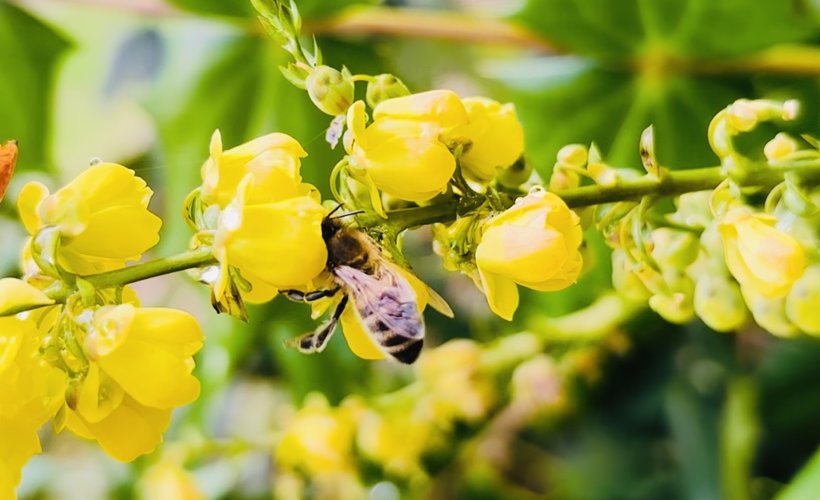
Every spring, around the time the days start to feel properly light again, I find myself watching the garden with a kind of quiet hope. Waiting for the first bumblebee, the first honeybee, the first of the many solitary bees.
It’s always a moment that makes me smile – that first fuzzy body bumbling its way across the flower beds, doing its thing, completely unbothered by me.
If you feel the same way, this one’s for you. Because spring is actually the most important time of year for bees, and the spring flowers you plant now can make a real difference to whether they survive and thrive.
Why are spring flowers so important for bees?
Most people think of bees as a summer thing, but spring is where it all begins.
Queen bumblebees emerge from hibernation as early as February on mild days. They’re cold, hungry, and alone. At this point, they need to find early flowers for bees quickly to refuel, build a nest, and start a new colony. The Bumblebee Conservation Trust describes spring as the time when queens are “under maximum stress, foraging on their own as they establish their nests.” Even a single pot of the right flower on your doorstep can genuinely matter.
If they can’t find enough nectar and pollen, the colony won’t survive. That’s why planting even a few plants that attract bees or flowers for pollinators can have a real impact.
You can learn more about our work around saving the bees here.
What are the best spring flowers for bumblebees?
If you’re wondering what flowers attract bees in spring, these are some of the most reliable and easy options to grow.
Crocus
If you only plant one thing, make it crocus. These are some of the best flowers for bees in early spring, often blooming as early as February.
Their bright purple, yellow and white flowers provide one of the first food sources for emerging queens. Plant bulbs in autumn in lawns, borders or pots for an early burst of life.
Lungwort (Pulmonaria)
A brilliant but often overlooked bee friendly flower, lungwort produces blue and pink blooms in late winter and early spring.
It thrives in shade and is especially loved by early pollinators. A great choice if you’re looking for plants for bees in shady gardens.
Hellebores
Also known as Christmas rose, hellebores are one of the earliest flowers for bees, sometimes blooming from January onwards.
They’re perfect for low-light gardens and provide a steady food source when very little else is available.
Flowering fruit trees (cherry and apple)
If you have space, fruit trees are some of the best plants for pollinators.
Their blossom in spring attracts large numbers of bees, and even compact varieties can be grown in pots on patios or balconies.
Comfrey
Comfrey is a favourite with long-tongued bumblebees. Its bell-shaped flowers are rich in nectar and appear in late spring.
It’s also incredibly useful in the garden, making it one of those plants that bees love… that gives back in more ways than one.
Chives
Chives are one of the easiest plants for potting that bees love. Their purple pompom flowers are irresistible to bees and perfect for small spaces.
You’ll also have fresh herbs for the kitchen, which makes them a win-win.
Dandelions
Often seen as weeds, but actually one of the most valuable early spring flowers for bees.
If you’re wondering what flowers do bees like when little else is in bloom, this is your answer. Leaving a patch of lawn unmown in early spring can make a big difference.
You can read more about bee friendly flowers on our blog here and if you are in the mood to learn how to create a wildflower meadow of your own, check out our blog post here.
Do bees have favourite flowers or colours?
Bumblebees can see ultraviolet light, which means they perceive colours very differently to us. But the research is pretty consistent: bees are drawn to purples, blues, and mauves more than other colours. That’s partly why crocus, lungwort, chives, and lavender are so popular with them.
That said, it’s less about colour and more about shape. Bumblebees have different tongue lengths depending on the species, and they need flowers to match. Short-tongued species like the buff-tailed bumblebee prefer open, accessible flowers where the nectar is easy to reach. Long-tongued species like the garden bumblebee can get into deep, tubular flowers like foxgloves and honeysuckle.
The practical takeaway? Plant a variety: a mix of open daisy-like flowers and deeper tubular ones will feed the widest range of species.
Can I attract bees with a small garden or balcony?
Yes, absolutely.
Even a few pots can become a valuable food source. If you’re looking for bee friendly flowering plants for a small garden, try:
- Crocus bulbs
- Chives
- Lavender
These are easy to grow and work well in small spaces. In urban areas especially, these small pockets of planting help create a network of food sources for pollinators moving between gardens.
What should I avoid planting if I want to help bumblebees?
If you want to support bees, there are a couple of things to watch out for:
Double flowers
These are often bred for appearance rather than function. The extra petals can block access to nectar, making them less useful for bees.
Pesticides
Some garden chemicals, particularly those containing neonicotinoids, can harm bees. Avoid spraying when flowers are open and choose bee-safe alternatives where possible.
A note from us
Spring always feels like a fresh start, and not just because the garden comes back to life. It’s a reminder that small things genuinely matter: one pot of crocus or a small patch of lawn left unmowed, or a single hellebore tucked under a shady tree. None of it has to be complicated and all of it helps.
We are a family business of beekeepers and make a range of 100% natural skincare from beeswax, honey and other carefully sourced ingredients, because we believe in the power of nature and the importance of looking after it, as well as looking after the skin you’re in.
As well as making award winning skincare, we are on a mission to help bring back our nation’s meadows, hedges and trees – and the wide variety of pollinators they support – we donate 10% of our profits to meadow restoration and like to share the joy (and importance of) all bees and pollinators 🐝
Julie Macken

After graduating with a Chemistry Degree and subsequent MBA, Julie spent 25 years 'in corporate life' working in Sales and Marketing for companies including Unilever and GSK. Her 'aha moment' came whilst running a marketing workshop in Brazil persuading South Americans to eat plastic-packed frozen chips instead of fresh potato.
Realising there were more fulfilling ways to utilise her skills, Julie founded Neve's Bees a family skincare business – creating a unique range of waterless skincare, using only natural and sustainable ingredients blended with Oxfordshire beeswax, promoting healthy skin and a healthy eco-system. Following a lifelong passion, Julie is also studying part time for a degree in Traditional Herbal Medicine.
Julie lives in Rural Oxfordshire with her husband, 2 children, 3 cats, 4 hens, 5 beehives, 6-acre wildflower meadow…and Bella the Dog.